
Views: 0 Author: Site Editor Publish Time: 2026-04-28 Origin: Site


Managing complex industrial flow paths often forces engineers into awkward compromises. Diverting, mixing, or distributing fluid media typically results in bulky assemblies. These traditional layouts rely heavily on multiple standard valves and heavy tee-fittings. This conventional approach wastes valuable physical space inside cramped mechanical rooms. It also increases initial installation time and multiplies potential failure points across complex piping systems.
A specialized three-way Ball Valve solves this persistent problem. It elegantly consolidates multiple fluid control actions into a single, efficient manifold. This upgrade shrinks the system footprint and simplifies operational control.
While the basic mechanical premise appears simple, specifying the right unit requires deep technical consideration. Proper selection demands precise alignment of internal port geometry, seat configuration, and advanced actuation logic. In this guide, we will explore how to specify these components correctly. You will learn how to prevent costly system failures and optimize your overall Total Cost of Ownership.
Three-way ball valves utilize either an L-Port (for diverting/shut-off) or a T-Port (for mixing/distributing) configuration.
Replacing multiple two-way valves with a single three-way unit reduces spatial footprint by up to 60% and significantly lowers installation costs.
System reliability improves drastically due to the elimination of external piping joints—the source of most pipeline failures.
Proper procurement requires evaluating seat design (2-seat vs. 4-seat), actuator torque profiles, and strict identification of the "common port" for flow routing.
You cannot properly specify a multi-port control unit without understanding its fundamental internal mechanics. Operation hinges completely on one central opening known as the common port. This central connection acts as the primary inlet or primary outlet for your pipeline. It dictates exactly how the rotating internal sphere redirects media as it passes through the body.
Identifying the common port serves as the critical first step in system design. If you misidentify this base logic, your flow routing will fail immediately upon startup. The internal sphere features precise cutouts to manage this flow. Manufacturers machine these cutouts into two distinct shapes: the L-port and the T-port.
Mechanics: This design features a distinct L-shaped internal bore machined into the sphere. The unit typically rotates 90 degrees during operation. This rotation connects the common port to either the left side port or the right side port.
Capability: The L-port configuration provides exceptional flow diversion. It also allows for complete flow shut-off. Depending on the actuator position, you can stop fluid movement entirely. This makes it highly versatile for basic routing tasks.
Use Case: Industrial facilities rely heavily on L-port designs for fluid selection. They excel in switching between dual fluid sources. Engineers frequently install them for pump alternation sequences or dual-strainer setups. When one strainer requires maintenance, the valve seamlessly diverts flow to the backup unit.
Mechanics: This design utilizes a T-shaped internal bore. The geometry allows fluid to flow straight through the body. It also permits 90-degree directional turns and complex multi-directional open states.
Capability: Unlike its L-shaped counterpart, a standard T-port typically cannot achieve a full system shut-off. Doing so requires a highly specific actuator setup and customized internal stops. Engineers design T-ports specifically for continuous, active flow management rather than isolation.
Use Case: These units dominate bypass loop applications. They also perform beautifully in HVAC fluid mixing systems and precision chemical proportioning. When you need to blend cold and hot water to hit a specific temperature, the T-port handles the task perfectly.
Configuration Comparison Chart
Feature | L-Port Configuration | T-Port Configuration |
|---|---|---|
Primary Function | Diverting / Selecting | Mixing / Distributing |
Internal Bore Shape | "L" shape (90-degree angle) | "T" shape (Intersection) |
Full Shut-Off Capability | Yes (Standard feature) | No (Requires custom engineering) |
Typical Rotation | 90 Degrees | 90, 180, or 360 Degrees |
Best Applied For | Pump switching, dual filters | HVAC blending, bypass loops |
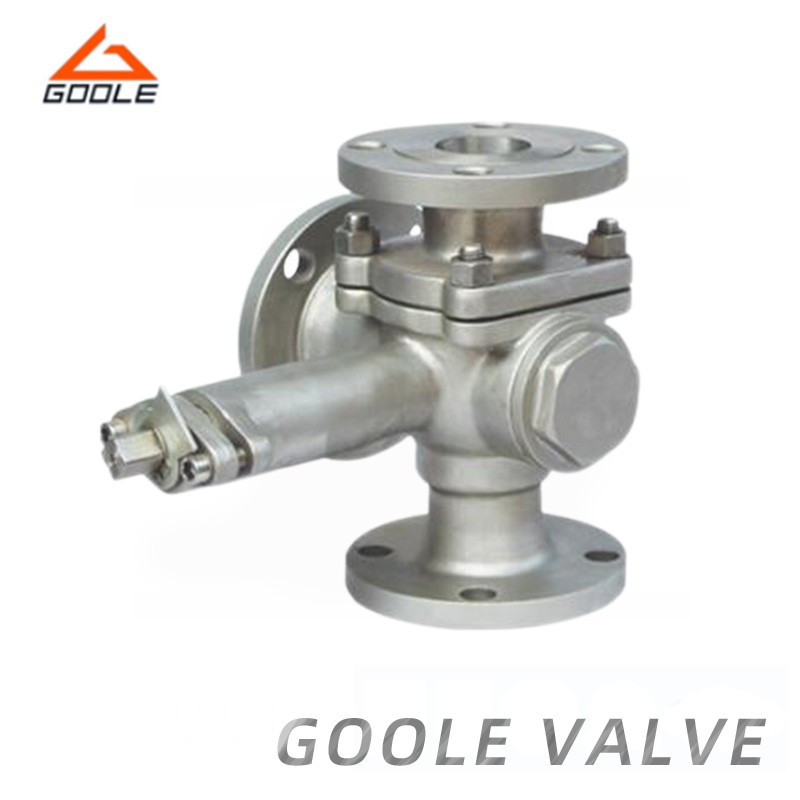
Basic port shapes dictate fluid direction, but internal construction dictates lifespan. Moving beyond basic flow paths reveals the engineering complexity hidden inside the body. Long-term reliability depends heavily on how manufacturers construct the internal seating and seal the exterior casing.
The valve seat forms the crucial seal against the rotating sphere. Selecting the wrong seat count guarantees premature internal leakage. Engineers must match the seat architecture to the port geometry.
2-Seat Design: Standard models usually feature a two-seat configuration. This approach remains highly cost-effective and structurally compact. Manufacturers primarily utilize 2-seat architectures for L-Port applications. In these setups, internal fluid pressure naturally assists the sealing mechanism. The fluid pushes the sphere firmly against the downstream closed port, ensuring a tight mechanical seal.
4-Seat Design: Complex routing demands a more robust approach. A 4-seat design proves absolutely required for demanding T-Port applications. This premium architecture surrounds the internal sphere entirely. It prevents unwanted leakage regardless of flow direction, pressure shifts, or sudden hydraulic surges. Four independent seats enable precise multi-port distribution without cross-contamination.
Fugitive emissions present a constant threat in industrial piping. Every physical joint represents a potential future leak path. When evaluating internal architecture, you must scrutinize the outer body construction.
Many economy components utilize standard multi-piece bodies. These require multiple threaded connections and gaskets to hold the assembly together. Conversely, premium units employ single end-cap designs. Fewer body joints translate directly to lower fugitive emission risks. A unified body structure also provides significantly enhanced structural integrity under extreme pressure. When pumping volatile chemicals or high-temperature steam, minimizing exterior casing joints becomes a paramount safety requirement.
Technical operation metrics matter, but commercial decision-making drives procurement. Upgrading your infrastructure requires a clear Bottom-of-Funnel justification. Moving from traditional assemblies to integrated components offers massive business advantages.
Consolidated Footprint: Real estate inside mechanical rooms costs a premium. A single three-way unit entirely replaces two conventional two-way units and a bulky tee-fitting. This physical consolidation resolves extreme spatial constraints. It proves especially valuable in custom equipment skids and highly compact piping corridors. You reclaim up to 60% of the required installation footprint.
Reliability and Leak Reduction: Maintenance teams spend countless hours chasing joint leaks. Engineering statistics indicate the vast majority of piping failures occur at threaded or flanged connection joints. By replacing three standard fittings with one integrated manifold, you remove critical failure points. Fewer mechanical components mean inherently higher system reliability. This directly drives down lifecycle maintenance costs over a 10-year operational span.
Automation & Control Efficiency: Modern industrial layouts rely heavily on automation. Synchronizing multiple actuated two-way units demands extensive programming. Upgrading to a single actuated three-way Ball Valve transforms your control system efficiency. You require fewer I/O points on your controller. Your electricians run significantly less wiring across the plant. Most importantly, it drastically simplifies PLC programming, saving hours of costly integration labor.
Buyers ready to specify and purchase need a highly actionable, structured standard operating procedure. Guesswork during the procurement phase leads to catastrophic installation delays. Follow this rigorous 5-step framework to guarantee project success.
Confirm Functional Requirement: Start by defining your ultimate process goal. You must decide strictly between diverting fluid (requiring an L-Port) or mixing/splitting fluid (requiring a T-Port). Never attempt to force an L-Port to mix media. Do not rely on a standard T-Port to provide a bubble-tight system shut-off.
Verify Port Mapping & Overlap Logic: Always audit the manufacturer flow plan diagrams before issuing a purchase order. You must identify the exact location of the common port. Furthermore, ensure the actuator travel limits align perfectly with your required open and closed states. Watch out for unintended crossover (known as overlap) during the transition between ports.
Determine Physical Parameters: Map out the exact pipeline parameters. Record the nominal pipe size and required connection type (flanged, threaded, or welded). Determine the maximum working pressure using standard ANSI class ratings. Finally, map the absolute operating temperature extremes your media will reach.
Select Compatible Materials: Chemical compatibility dictates longevity. Specify the main body metal carefully. Standard choices include 316 stainless steel, brass, and bronze. Next, match specialized seat and seal materials to your specific fluid. Use virgin PTFE for general chemical resistance. Upgrade to Viton or specialized elastomers for high-temperature or highly abrasive media.
Define Actuation & Environmental Specs: Automating the unit requires careful calculation. Match the actuator torque output to the specific unit. You must account for the notably higher friction generated by 4-seat designs. Confirm your facility voltage requirements. Finally, select the proper IP or NEMA enclosure ratings. An outdoor installation requires robust environmental protection against rain and dust ingress.
Even the highest-quality components fail if implemented poorly. Highlighting realistic pitfalls and rollout lessons helps prevent expensive rework. Watch out for these three common engineering mistakes during installation.
Orientation and Installation Errors: Technicians frequently install these units backwards relative to the common port. This simple orientation error leads to immediate process failure. In closed-loop systems, a reversed installation can cause severe internal pressure trapping. Always verify the directional arrows cast into the metal body before welding or threading the unit into place.
Actuator Torque Under-sizing: Engineers sometimes assume a three-way unit requires the same torque as a standard two-way unit of the same size. This proves false. Failing to account for the dramatically increased breakaway torque required in multi-seat architectures results in stalled actuators. Always apply a generous safety factor to your torque calculations when sizing pneumatic or electric drives.
Water Hammer on Quick Closure: Fast-acting actuators can destroy piping networks. In high-velocity lines, transitioning between ports too quickly generates severe hydraulic shock. This phenomenon, known as water hammer, shatters pipe joints and blows out internal seals. You must specify appropriate actuator stroke times. Using speed control valves on pneumatic actuators prevents rapid transitions and protects the entire pipeline network.
Understanding the basic operation of a three-way routing unit represents only the baseline of industrial piping design. The real commercial and operational value lies much deeper. You must meticulously match port geometry, internal seat architecture, and precise flow logic to your exact process requirements. Doing so dramatically reduces your total footprint, lowers lifecycle maintenance costs, and eliminates dangerous external leak paths.
We urge engineering buyers to consult detailed manufacturer flow diagrams meticulously before finalizing any procurement decisions. Do not guess on port mapping. To ensure a flawless installation, recommend your team review technical spec sheets and download dimensional CAD models today. If you encounter complex routing challenges, contact a dedicated application specialist to verify your specific flow logic before issuing a purchase order.
A: The primary difference lies in their internal fluid routing capabilities. An L-port features a 90-degree internal bore designed specifically for diverting flow from one source to another, and it can shut off flow entirely. A T-port features an intersecting bore designed for mixing or splitting media across multiple directions simultaneously.
A: Yes, but typically only when using an L-port configuration. The L-shape allows the internal sphere to block flow completely depending on the handle position. Standard T-ports are engineered for continuous flow distribution and generally cannot achieve total system shut-off.
A: Yes. It requires an actuator specifically calibrated for the unique 90°, 180°, or 360° rotation flow path of the selected port design. Furthermore, the actuator must be sized to handle the higher breakaway torque generated by the additional internal friction of multi-seat configurations.
A: Absolutely. Replacing a static tee-fitting with an integrated three-way unit allows you to exert active flow control directly at the piping junction. This eliminates the need to install separate two-way shut-off valves downstream of a passive flow separation point, saving immense space.


