
Views: 188 Author: Site Editor Publish Time: 2025-07-05 Origin: Site


In numerous industries, including chemical processing, pharmaceuticals, food and beverage, water treatment, and oil & gas, the ability to efficiently control fluid flow is paramount. Valves are fundamental components of piping systems, serving as the gateways that regulate, divert, or mix fluids. Among various valve types, the Three Way Ball Valve stands out due to its multifunctional capabilities and compact design. Unlike traditional two-way ball valves that only open or close a single pipeline, three way ball valves have three ports, allowing more complex flow control functions such as diverting flow from one pipeline to two different paths or mixing fluids from two inlets into one outlet.
The heart of a three way ball valve is its spherical ball with internal flow passages. The key components that enable its unique functionality include:
Valve Body: The outer casing that provides mechanical strength and connects the valve to the pipeline.
Ball (Spherical Plug): The rotating element inside the valve with specially designed hollow passages, enabling flow control.
Stem: The shaft connecting the ball to the handle or actuator, enabling the ball’s rotation.
Seats and Seals: Typically made of PTFE or other resilient materials, seats provide tight sealing between the ball and the valve body, ensuring no leakage.
The internal hollow of the ball is engineered either as an L-shaped or T-shaped port. This design directly affects how the flow is controlled.
L-Port Ball: The passage resembles the letter “L,” connecting two adjacent ports at any given time, while the third port remains closed. This design allows switching flow between two outlets or inlets but does not support simultaneous mixing.
T-Port Ball: The passage resembles the letter “T,” connecting multiple ports simultaneously depending on the ball position. It can connect all three ports together or any two while isolating the third, offering a high degree of flexibility for mixing or diverting flows.
The precision machining of these ports and the ball surface is essential for smooth operation and excellent sealing performance.
At the core of its operation, a three way ball valve controls fluid flow by rotating the ball inside the valve body, thereby aligning the internal ports with the valve’s external pipeline ports.
L-Port Valve Operation:
In the L-Port configuration, the valve can connect one inlet port to either of two outlet ports by rotating the ball 90 degrees. For example, if Port 1 is the inlet and Ports 2 and 3 are outlets, turning the valve will direct the flow from Port 1 to Port 2 while closing Port 3, or switch it from Port 1 to Port 3 while closing Port 2. This functionality is invaluable for applications that require flow diversion but no mixing.
T-Port Valve Operation:
The T-Port ball valve offers three main flow configurations:
Mixing: Connects two inlets to one outlet, allowing two fluid streams to combine.
Diverting: Routes fluid from one inlet to either of two outlets.
Three-way connection: Connects all three ports simultaneously, enabling more complex flow routing.
This versatility makes T-Port valves highly valuable in systems requiring dynamic flow control or blending.
Three way ball valves generally have 90-degree or 180-degree rotational operation, depending on design and actuator. The handle or actuator rotates the ball to preset positions:
Position 1: Connects Port A to Port B, closing Port C.
Position 2: Connects Port A to Port C, closing Port B.
Position 3 (for T-Port): Connects Ports A, B, and C simultaneously.
Each position serves different operational needs, enabling quick and reliable flow changes.
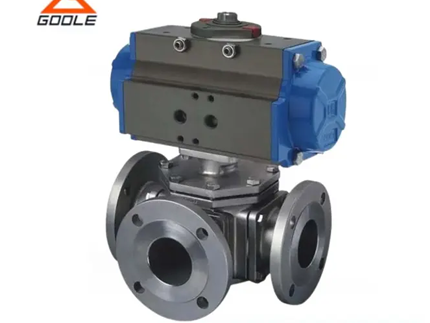
How the three way ball valve is operated depends on system requirements, automation level, and operational safety.
Manual valves use a lever or handle directly connected to the valve stem. The operator rotates the handle to switch flow paths.
Advantages:
Simple, low cost.
Easy to install and maintain.
Useful for systems with infrequent switching or remote locations without automation.
Disadvantages:
Requires manual presence and physical effort.
Not suitable for fast or frequent operation.
Pneumatic actuators use compressed air to drive the valve stem, allowing remote and automated control.
Advantages:
Fast, precise operation.
Suitable for hazardous or explosive environments due to air operation.
Integrates well with control systems for process automation.
Considerations:
Requires a clean compressed air supply.
Needs additional infrastructure for air lines and controls.
Electric actuators consist of motors controlled by electrical signals to rotate the valve stem.
Advantages:
Precise positioning and feedback capabilities.
Programmable control integration with SCADA or DCS systems.
Ideal for complex automated process control.
Considerations:
Requires power supply and may not be suitable for explosive atmospheres without proper certification.
The choice between manual, pneumatic, or electric actuation depends on operational needs, valve size, frequency of switching, and environmental factors.
The selection between L-Port and T-Port configurations is critical and depends on the intended application.
Flow Switching/Diverter Systems: Redirect fluid from one inlet to either of two outlets without mixing.
Process Lines: Where contamination or cross-flow is unacceptable.
Example: Diverting a chemical stream between two different reactors for batch processing.
Mixing Systems: Combine two fluid streams into one output, such as blending hot and cold water.
Diverting and Mixing Combined: Can divert flow and mix fluids in the same valve.
Example: HVAC systems where heating and cooling water are mixed to achieve temperature control.
Choosing the correct port configuration helps optimize system performance and reduces the need for additional valves or piping.
Three way ball valves are used widely across sectors due to their flexibility and reliability.
Chemical Industry: Precise routing of reactive chemicals, batch processing, and blending.
Pharmaceutical Industry: Maintaining sterile conditions while switching fluid paths.
Food & Beverage: Diverting product streams or mixing ingredients hygienically.
Water Treatment: Managing flow between filtration, storage, and treatment units.
HVAC: Controlling temperature through water flow mixing/diverting.
Oil & Gas: Managing multiple pipeline routes and safety systems.
Their compact size, ease of automation, and reliable sealing make three way ball valves ideal for critical industrial applications.
A three way ball valve is a versatile, efficient, and reliable component vital to modern fluid control systems. Its internal ball design with L or T-shaped ports allows switching, mixing, or diverting flows in compact and cost-effective ways.
By understanding the valve’s internal structure, flow switching mechanisms, actuation methods, and port configurations, engineers and operators can select and apply these valves optimally to improve system performance, reduce downtime, and save costs.
Whether manually operated or automated with pneumatic or electric actuators, three way ball valves offer precise control in a wide range of industries and applications. Proper knowledge of their working principle is essential for designing effective fluid control solutions.
For more detailed technical specifications, product options, and expert support, please visit Valve Technology Co., Ltd. at www.chinagoolevalve.com.


