
Views: 0 Author: Site Editor Publish Time: 2026-10-28 Origin: Site


Natural gas transmission networks operate at the very edge of mechanical limits. Volatile media, extreme pressures, and vast geographical distances demand absolute precision. Standard flow control mechanisms frequently fail in these unforgiving environments. They become dangerously difficult to operate under intense pipeline stress. Such failures are not merely operational inconveniences. They introduce severe safety risks and catastrophic environmental hazards, ultimately causing crippling financial downtime.
To overcome these high-pressure challenges, pipeline engineers rely on a specific and robust solution. A high-performance Trunnion ball valve is engineered to safely absorb massive hydraulic thrusts. This mechanical advantage ensures reliable shut-off and operational ease even in the most demanding midstream sectors. This comprehensive guide explores the intricate mechanics of these essential components. We will examine their critical applications in gas conveyance and the vital criteria procurement teams must evaluate to secure long-term infrastructure stability.
Key Takeaways
Trunnion-mounted designs are indispensable for natural gas pipelines. They are mechanically equipped to manage extreme pressure differentials with significantly lower operating torque.
Critical safety mechanisms include Double Block and Bleed DBB, fire-safe metal-to-metal secondary seals, and anti-static devices. These are non-negotiable field requirements.
Rigorous material selection directly dictates the structural integrity and operational lifespan of the pipeline. Strict NACE compliance is essential for sour gas environments.
Mandatory adherence to international manufacturing and testing standards ensures regulatory compliance and facility safety. API 6D and API 607 are the primary industry benchmarks.
Specifying the correct actuation mechanism while maintaining routine sealant injection schedules drastically reduces the Total Cost of Ownership.
Midstream gas transmission networks endure severe conditions that constantly test the boundaries of modern metallurgy. Mainline operating pressures frequently exceed 1,000 PSI and can surge dramatically. Elevation changes and compressor proximity drive these sudden spikes. Furthermore, the transported media is highly volatile and rarely pristine. It often carries abrasive impurities like sand, pipe scale, and liquid condensates. Fluctuating ambient temperatures induce brutal thermal expansion and contraction across miles of steel pipe. The operating environment quickly becomes exceptionally hostile. Achieving a bubble-tight shut-off is paramount under these unpredictable variables. A microscopic leak can escalate into a massive environmental hazard and result in millions of dollars in product loss.
One must compare the two primary internal designs to fully grasp why specific equipment is chosen for midstream pipelines. In a traditional floating configuration, the ball is suspended purely by the compression of the upstream and downstream polymeric seats. High-pressure gas hits the valve and physically forces the ball downstream. It crushes against the seat to create a temporary seal. This works adequately in small and low-pressure lines. In contrast, it creates unmanageable friction in large-diameter transmission pipelines. A field technician attempting to cycle a massive floating valve under high pressure would face tremendous operating torque.
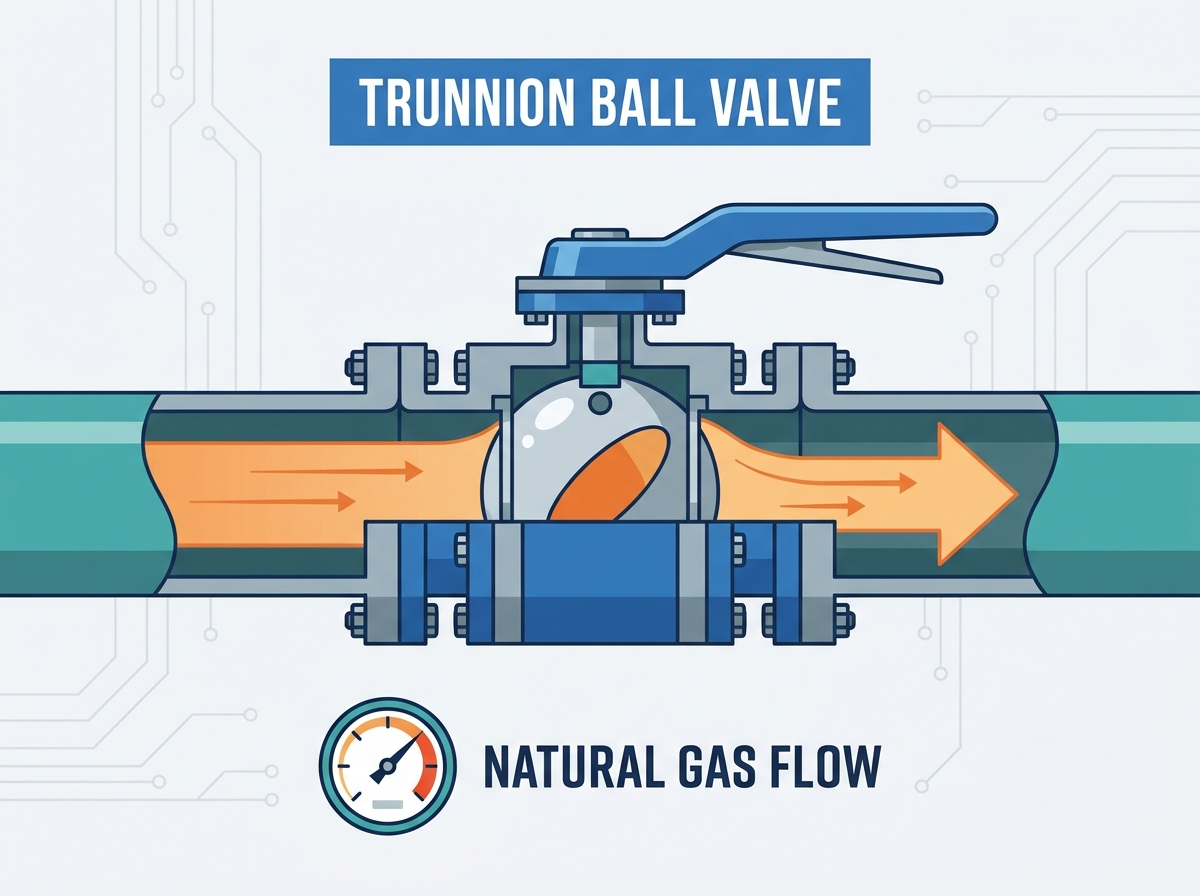
The trunnion design features a mechanically anchored ball. Robust upper and lower shafts support this core component. The trunnions absorb the immense line pressure rather than relying on the seats to hold the ball in place. This prevents the ball from shifting downstream. Specifically, it protects the seats from being crushed and drastically minimizes the friction required to rotate the internal components.
The most immediate engineering advantage of the anchored trunnion design is the substantial reduction in operational friction. The heavy hydraulic thrust is absorbed by the structural shafts rather than the seating surfaces. This perfectly balances the mechanical load. Consequently, this translates to a remarkably lower operating torque. Pipeline operators leverage this mechanical efficiency to deploy significantly smaller and more cost-effective actuators. In practice, this reduces initial capital expenditure. It limits the structural weight suspended on the pipeline and lowers the ongoing energy consumption required during emergency shutdowns.
Maintenance efficiency and personnel safety are critical priorities in gas transmission facilities. Therefore, these heavy-duty valves are engineered with Double Block and Bleed or Double Isolation and Bleed capabilities. These systems utilize independent and spring-loaded seats that maintain constant contact with the ball. A DBB configuration allows operators to isolate high-pressure gas on both the upstream and downstream sides simultaneously. A technician can safely open a dedicated bleed valve on the body cavity to vent any trapped gas once the line is isolated. This mechanism is an absolute necessity for conducting inline maintenance. It verifies zero-leakage integrity without forcing a complete system shutdown.
Compressed methane is highly combustible. Flow control equipment must incorporate fail-safe mechanisms to prevent ignition and contain the media during catastrophic emergencies.
Fire-Safe Design: Primary elastomeric seals like PTFE will quickly melt in the event of a facility fire. Fire-safe valves are machined with a secondary metal lip. The line pressure pushes the ball slightly downstream against this metal lip when the soft seat burns away. This creates a reliable metal-to-metal seal that prevents the valve from feeding the fire.
Anti-Static Devices: High-velocity gas flow generates hazardous static electricity. Built-in anti-static springs are installed to mitigate this hidden danger. They ensure continuous electrical grounding between the ball, stem, and valve body.
Blow-Out Proof Stem: The stem is machined with an integral shoulder to withstand extreme internal pressure surges. This physical barrier ensures the stem cannot be ejected outward from the valve body. It reliably protects nearby operators from lethal projectiles.
Compressor stations serve as the beating heart of any transmission network. They generate the immense pressure required to push gas across continents. Within these complex facilities, a natural gas ball valve is strategically deployed to isolate individual compressor units. This allows maintenance crews to perform routine repairs without halting the flow of the entire station. Similarly, these components provide bubble-tight isolation within metering and regulating skids. This mechanical precision is a strict legal requirement for custody transfer and billing operations.
Automated Emergency Shutdown systems must react in milliseconds when a pipeline rupture or sudden pressure drop occurs. These valves act as the primary defense mechanism when equipped with rapid-acting actuators. Their unique ability to close swiftly and reliably against maximum differential pressure ensures that compromised pipeline segments are isolated immediately. This swift action mitigates environmental devastation and prevents large-scale explosions.
Operators frequently deploy specialized tools inserted directly into the pipeline to maintain internal hygiene. These tools sweep away condensates and perform ultrasonic non-destructive testing. Pig launching and receiving stations require flow control components that offer a completely unobstructed flow path. Full-bore designs are mandatory in these locations. Their internal diameter perfectly matches the pipeline bore. This allows the inspection tools to glide seamlessly through the valve body without getting wedged or damaging internal components.
The structural longevity of any pipeline component is fundamentally tied to its metallurgy. For standard overland gas transmission, forged carbon steel like ASTM A105 or cast carbon steel WCB remains the industry standard. These materials offer an optimal balance of high tensile strength and economic viability. Engineers must upgrade to stainless steel grades like F304 or F316, or advanced Duplex alloys, when pipelines traverse harsh offshore environments. When sourcing a reliable pipeline ball valve, procurement specialists must carefully match the exact chemical composition of the transported gas with the appropriate metallic housing. This strict matching prevents premature degradation. Premium forged materials are often specified for sizes ranging from 2 inches up to 48 inches to ensure absolute structural density.
The internal seating material dictates both the sealing capability and the erosion resistance of the equipment. Soft seats manufactured from resilient polymers like PTFE, Nylon, or PEEK are highly preferred for refined natural gas. They effortlessly provide a bubble-tight seal. PEEK is particularly utilized when temperatures and pressures spike. Standard polymers will quickly shred if the gas stream is raw and laden with abrasive particulates. Metal-to-metal seats coated with ultra-hard Tungsten Carbide or Chromium Carbide are deployed in these aggressive scenarios. They easily withstand the relentless scouring action of the pipeline debris.
Natural gas containing high concentrations of Hydrogen Sulfide is termed sour gas. This media is not only lethally toxic but also profoundly corrosive. It induces a rapid failure mechanism known as Sulfide Stress Cracking in standard carbon steels. Every component in contact with the media must strictly comply with NACE MR0175 or ISO 15156 standards to survive these lethal conditions. This certification guarantees that the metal alloys have undergone highly specific heat treatments and hardness controls. They will not turn brittle and shatter under sour gas exposure.
Equipment failure is simply not an option in the realm of midstream oil and gas. The American Petroleum Institute API 6D specification stands as the definitive global benchmark for pipeline flow control. A product that achieves API 6D certification has survived an exhaustive battery of tests. These include intense hydrostatic shell testing and stringent seat leak verification. This standard provides empirical proof that the equipment can handle maximum rated pressure differentials without compromising its structural integrity.
Standard polymeric seals present a massive vulnerability during a facility fire. Equipment must be designed and rigorously tested to API 607 or API 6FA standards to prevent a compromised valve from feeding volatile methane into an ongoing blaze. The pressurized valve is engulfed in flames exceeding 750 degrees Celsius for an extended duration during these brutal tests. The internal metal-to-metal secondary seals and the external high-temperature graphite packing must successfully contain the gas within strictly defined leakage thresholds to pass.
Minimizing greenhouse gas emissions is a top priority for energy companies as global environmental regulations tighten. Methane is an incredibly potent greenhouse gas. Microscopic leaks known as fugitive emissions often escape through older stem packings. Standards like ISO 15848 dictate exhaustive thermal and pressure cycling tests to evaluate stem seal endurance. Modern compliant designs utilize sophisticated graphite and polymer packing combinations. This ensures that zero methane escapes into the atmosphere over the equipment lifecycle.
The midstream sector is currently undergoing a massive technological evolution. Recent market analyses highlight a rapid industry-wide shift toward digitalization and strict Environmental, Social, and Governance ESG compliance. Pipeline operators are increasingly integrating smart actuation systems equipped with Industrial Internet of Things sensors. These intelligent devices continuously monitor torque signatures, acoustic leakage, and stem friction in real-time. Maintenance teams can transition from reactive repairs to predictive maintenance, thereby eliminating unplanned outages.
Furthermore, there is a growing trend of blending hydrogen into existing natural gas networks as the global energy mix transitions toward cleaner alternatives. Hydrogen molecules are significantly smaller than methane and notoriously prone to embrittling standard steels. Consequently, industry engineers are actively adapting metallurgical formulas and tightening machining tolerances to accommodate hydrogen-blended streams. This proactive approach ensures that today's infrastructure remains viable for tomorrow's energy demands.
Procurement begins with precise sizing. The internal bore must perfectly match the pipeline to prevent pressure drops and allow for seamless pigging operations. Industrial sizes typically range from 2 inches up to massive 48-inch configurations. Selecting the correct ASME B16.34 pressure class is equally critical. This dictates the wall thickness and bolting strength required to safely contain the media. Proper selection ensures the valve body can handle the specified rating from Class 150 up to Class 2500.
ASME Class | Approximate Max Pressure at Ambient Temp | Typical Pipeline Application |
|---|---|---|
Class 150 | 285 PSI | Low-pressure gathering lines and local distribution. |
Class 300 | 740 PSI | Mid-stream gathering and regional transmission. |
Class 600 | 1,480 PSI | Standard high-pressure cross-country mainlines. |
Class 900 | 2,220 PSI | High-pressure compressor stations and isolation. |
Class 1500 to Class 2500 | 3,705 PSI to 6,170 PSI | Extreme pressure injection and specialized deep-well processing. |
Transmission lines often traverse remote and unpopulated terrains lacking electrical grids. Selecting the appropriate actuation mechanism is a matter of critical safety in these isolated areas. Pneumatic and electric actuators dominate localized facilities. However, Gas-over-Oil actuators are the undisputed standard for remote pipelines. A GOV system ingeniously taps into the pipeline pressurized gas to drive hydraulic fluid. This fluid then strokes the valve. This self-contained loop ensures the valve can perform an emergency shutdown instantly, even during a total blackout.
The complex engineering required for extreme-pressure environments dictates that procurement teams must meticulously vet their manufacturing partners. A reliable manufacturer must possess a documented history of API 6D compliance. They need robust in-house non-destructive testing capabilities and a flawless quality assurance program. Sourcing equipment from a facility that provides full material traceability and certified test reports is the only way to guarantee long-term field reliability.
Even the most advanced engineering will succumb to premature failure if subjected to improper field installation. These heavy-duty components must be hoisted exclusively by their engineered lifting lugs. Lifting by the actuator or stem will cause severe mechanical distortion. Welders must follow strict thermal guidelines for fully welded body configurations often used underground to eliminate flanged leak paths. Continuous temperature monitoring and water-cooling techniques are required during field welding. This prevents extreme heat from traveling through the body and melting the internal polymeric seats.
These heavy-duty valves are generally considered low-maintenance. However, they feature a critical emergency mitigation system via sealant injection fittings located at the stem and seat rings. It is vital to understand that this is not for routine lubrication. Operators can inject a highly viscous synthetic sealant directly into the damaged area if a soft seat is deeply scored by pipeline debris. This creates a temporary high-pressure barrier that stops the gas leak. The pipeline remains operational until a scheduled maintenance window permits internal repairs.
Rapid diagnostics can prevent minor anomalies from escalating into catastrophic blowouts. An unexpected spike in operating torque typically indicates a buildup of hardened debris in the seat pockets or a lack of lubrication in the trunnion bearings. Downstream seat leakage often points to a scratched ball surface caused by pipeline particulates. Regular monitoring of actuator supply pressure and inspecting the stem packing for fugitive emissions are essential. Periodically cycling valves that remain static for months will mitigate the vast majority of mechanical issues.
Compromising on equipment quality is never an option when the safety of your personnel and the integrity of your infrastructure are on the line. Goole Valve brings decades of specialized engineering expertise to the midstream sector. We manufacture high-performance flow control solutions tailored for the most brutal operating conditions. Every single product is subjected to uncompromising API-compliant testing protocols to ensure absolute field reliability. Our valves feature robust cast or forged bodies in materials like WCB, LCB, A105, F304, and F316. We cover sizes from 2 inches up to 48 inches and pressure ratings from Class 150 to Class 2500. By leveraging advanced metallurgy, precision machining, and fully customizable actuation packages, integrating our premium flow control products guarantees reduced emissions and lower operating torque. Please visit Goole Valve to explore our full range of solutions and significantly optimize the total cost of ownership for your next major pipeline project. Contact our expert engineering team today for technical consultations and custom configurations tailored specifically to your infrastructure challenges.
The ball is structurally supported entirely by the polymeric valve seats in a floating configuration. The ball is violently forced against the downstream seat when subjected to high pressure. This causes severe friction, massive operating torque, and rapid wear. A trunnion design features a mechanically anchored ball supported by top and bottom shafts. This framework absorbs the hydraulic thrust. It prevents the ball from crushing the seats and dramatically reduces the rotational torque required.
Gas transmission networks operate at immense pressures across large pipeline diameters. Trunnion designs are specifically engineered to thrive in these demanding conditions. They provide substantially lower operating torque and verifiable Double Block and Bleed capabilities for safe inline maintenance. Critical fail-safes like fire-safe sealing and blow-out proof stems make them the most secure choice for the midstream sector.
API 6D is the internationally recognized gold standard established by the American Petroleum Institute for pipeline flow control equipment. A product carrying this certification guarantees that the unit has been designed, manufactured, and exhaustively tested. These tests include brutal hydrostatic and seat leak protocols to ensure the valve can withstand the severe mechanical demands of oil and gas conveyance.
No. These components are strictly engineered for isolation applications. Attempting to leave the valve partially open to regulate flow exposes the soft polymeric seats to the high-velocity and abrasive stream of natural gas. This action will cause rapid cavitation, severe erosion, and structural degradation of the seating surfaces. It inevitably results in catastrophic internal leakage.
A fully welded valve is manufactured without any bolted body joints. The entire housing is seamlessly fused together. This specialized construction completely eliminates potential external leak paths through body gaskets. They are predominantly utilized in buried underground gas pipelines or subsea installations where maintenance access is virtually impossible and absolute structural integrity is mandated.
Heavy-duty designs frequently feature specialized injection fittings machined into the stem housing and seat rings. Maintenance personnel can pump a heavy synthetic sealant through these fittings if a polymeric seat is gouged by abrasive pipeline debris. The sealant fills the damaged voids. This creates a temporary high-pressure barrier that stops the gas leak until the line can be safely isolated and the internal components replaced.
The operational lifespan heavily depends on the operating environment, media purity, and maintenance frequency. A properly specified and maintained valve in clean natural gas service can easily last 20 to 30 years. However, exposure to severe sour gas or heavy particulate loads without regular sealant maintenance and cycling can significantly reduce this timeframe. Strict adherence to API standards and NACE compliance ensures the maximum possible longevity.
Field technicians typically rely on the Double Block and Bleed mechanism to verify seat integrity. Operators close the valve and pressurize the pipeline. They then open the dedicated bleed valve located on the body cavity. Any continuous flow of gas from the bleed valve indicates that the upstream or downstream seats are failing to provide a bubble-tight seal. This procedure allows for safe and inline diagnostic testing without removing the equipment from the pipeline.


