
Views: 188 Author: Site Editor Publish Time: 2025-06-18 Origin: Site


In industrial piping systems, three way ball valves play a pivotal role in controlling fluid flow efficiently. Whether the goal is to divert flow, mix fluids, or switch flow paths, the valve’s port configuration fundamentally affects its functionality. The two primary types of port designs in three way ball valves are L-Port and T-Port. Choosing the correct port type is crucial because it influences the valve’s operational flexibility, the complexity of fluid routing, and ultimately, the system’s efficiency and cost.
An L-Port three way ball valve features a ball with an internal passage shaped like the letter “L.” This design means the ball has two flow paths connecting two ports at a time, while the third port is blocked. Essentially, the valve can switch fluid flow between two ports but cannot connect all three ports simultaneously.
When the valve handle or actuator rotates the ball by 90 degrees, the flow path switches between two adjacent ports:
In Position 1, the valve connects Port A to Port B, allowing flow between these two.
In Position 2, the valve connects Port A to Port C, diverting the flow to a different outlet.
In both positions, the third port remains closed, effectively blocking flow to or from that port.
Flow diversion: Redirecting a single fluid stream between two different pipelines without mixing.
On/Off switching between two outlets: For instance, choosing between two different process lines.
Batch processes: Switching the flow from one reactor or tank to another.
Safety and isolation: Preventing cross-contamination by ensuring only one outlet is open at a time.
A T-Port three way ball valve has a ball with a T-shaped internal passage, enabling more versatile flow configurations than the L-Port. This design allows for the connection of any two ports or all three ports simultaneously, depending on the ball’s rotation.
The T-Port valve provides three primary flow positions:
Position 1: Connects Port A to both Ports B and C, allowing the fluid to flow from one inlet to two outlets simultaneously (diverting).
Position 2: Connects Ports A and B, isolating Port C.
Position 3: Connects Ports B and C, closing Port A.
This flexibility enables mixing two inlet streams into one outlet or diverting one inlet stream into two outlets simultaneously.
Mixing: Combining two fluid streams into a single output, such as blending hot and cold water to achieve a specific temperature.
Diverting: Splitting a single flow into two outlets for parallel processing.
Bypass and recirculation systems: Managing complex flow paths in HVAC or chemical processing.
Multi-directional flow control: Where the system requires different flow routes or simultaneous connections.
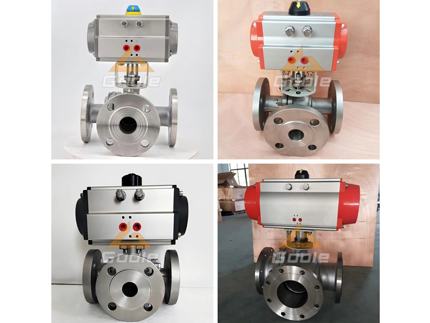
The L-Port ball has a simpler internal passage shaped like “L,” connecting two ports at a time.
The T-Port ball features a more complex “T”-shaped passage allowing multiple connection combinations.
These structural differences impact how the valves control fluid flow and how they can be integrated into piping systems.
Feature | L-Port Valve | T-Port Valve |
Number of simultaneous flow paths | One connection at a time (2 ports) | Can connect two or three ports simultaneously |
Flow control type | Switching/diverting only | Mixing, diverting, or bypassing |
Port closure flexibility | Closes one port at all times | Can isolate one port or connect all |
Flow paths complexity | Simple | Complex |
Typical rotation angle | 90 degrees | 90 or 180 degrees |
Simple and reliable design: Fewer internal flow paths mean less risk of leakage or malfunction.
Better sealing: Because one port is always closed, sealing is more straightforward.
Cost-effective: Generally less expensive due to simpler construction.
Ideal for diverting: Perfect where flow must be directed exclusively to one outlet.
No mixing capability: Cannot combine two fluid streams simultaneously.
Limited flexibility: Only two flow paths possible at any time.
High versatility: Supports mixing, diverting, and bypass functions.
Multiple flow paths: Can connect all three ports simultaneously.
Process efficiency: Reduces the number of valves and piping needed in complex systems.
Better suited for automated control: Facilitates dynamic flow control in modern plants.
More complex design: Higher risk of leakage if not maintained properly.
Higher cost: More machining and materials required.
Sealing challenges: More flow paths can mean higher wear on sealing components.
Selecting the right valve port type requires evaluating your system’s functional requirements, fluid characteristics, and operational constraints.
Do you need to mix two fluids or only divert flow?
If mixing is necessary, choose T-Port.
If only diverting or switching flow paths, L-Port suffices.
Is simultaneous flow to two outlets required?
Yes → T-Port
No → L-Port
What is the fluid type and cleanliness?
For dirty or abrasive fluids, simpler L-Port valves may be more durable.
Are automation and precise flow control important?
Complex control favors T-Port with actuators.
Budget constraints?
L-Port valves tend to be more economical.
For simple flow diversion tasks (e.g., switching between two lines), the L-Port valve offers reliability and cost-efficiency.
For mixing applications (e.g., HVAC temperature control or chemical blending), T-Port valves provide necessary versatility.
In systems requiring dynamic flow routing or bypass, the T-Port configuration reduces the number of valves and simplifies piping.
Consider long-term maintenance: T-Port valves might need more frequent seal inspection.
Both L-Port and T-Port three way ball valves are vital tools in modern fluid control systems, but their suitability depends largely on the specific flow control functions required.
L-Port valves excel in simple, robust flow diversion applications where only one outlet needs to be active at a time.
T-Port valves are ideal for more complex systems involving mixing, diverting, or simultaneous multi-path flow.
Careful evaluation of your system’s operational needs, fluid properties, automation requirements, and budget will guide you to the best choice. Consulting with experienced valve manufacturers like Valve Technology Co., Ltd. (www.chinagoolevalve.com) can further ensure you select a high-quality valve that meets your performance expectations.


