
Views: 0 Author: Site Editor Publish Time: 2026-10-30 Origin: Site


In the high-stakes world of energy extraction and transport, pipeline failures are not just expensive. They are catastrophic. Selecting the right valve goes far beyond merely controlling fluid flow. It fundamentally revolves around ensuring site safety, preventing hazardous leaks, and optimizing long-term operational costs. Ball valves serve as the undisputed backbone of modern pipeline infrastructure. However, the choice between a floating and a trunnion design frequently confuses even seasoned procurement managers and field engineers.
While both mechanisms serve the fundamental purpose of isolating fluid, their distinct structural designs make them suited for entirely different operating conditions. Installing the incorrect type will inevitably lead to rapid equipment failure, severe safety hazards, and expensive facility downtime. This comprehensive guide breaks down the mechanical differences, engineering selection criteria, and practical field applications to help you choose the perfect equipment for your next project.
Key Takeaways
Design Difference: Floating designs rely on upstream line pressure to push the unanchored ball against the downstream seat for sealing. In contrast, trunnion designs feature a mechanically anchored ball with spring-loaded seats that move inward to create a secure seal.
Pressure and Size: Floating variants are highly effective for low-to-medium pressure systems and smaller pipeline sizes, typically under 6 inches. Trunnion models completely dominate in high-pressure, large-diameter applications where structural integrity is paramount.
Operating Torque: Fixed-axis designs require significantly less torque to operate. This mechanical advantage makes them easier and much more economical to automate compared to floating setups.
Cost-Effectiveness: A floating architecture offers a simpler, more economical solution for standard utility applications. Heavy-duty anchored valves demand a higher initial capital investment but deliver superior longevity and reliability in severe operational conditions.
A floating ball valve utilizes a straightforward yet highly effective internal design. In this configuration, the spherical ball is not mechanically anchored to a bottom stem or shaft. Instead, it is suspended directly within the fluid medium. Two elastomeric seats, located on the upstream and downstream sides, hold it securely in place.
When a field technician turns the valve to the closed position, the upstream fluid pressure exerts a physical force on the heavy steel ball. This hydrostatic pressure physically displaces the ball downstream. It compresses tightly against the downstream seat to create a leak-proof barrier. Consequently, the sealing effectiveness is directly proportional to the line pressure. Higher pressure results in a tighter seal, right up to the mechanical limits of the polymer seat.
The primary advantage of this design is its inherent cost-effectiveness. Because the internal architecture requires fewer components, it is significantly cheaper to manufacture. Field technicians also appreciate its compact, lightweight footprint. This makes it ideal for installations with strict space constraints. Additionally, it provides excellent bi-directional sealing capabilities in low-pressure environments.
On the downside, performance degrades rapidly under high pressure. Because the fluid physically forces the ball against the downstream seat, elevated pressure creates immense friction. When an operator attempts to manually open or close the system, the physical resistance can be overwhelming. Furthermore, excessive thrust will permanently deform or completely crush the elastomeric seats, leading to catastrophic blowouts. As a result, engineers generally restrict these units to smaller sizes, usually 6 inches or smaller, and lower pressure classes like ASME Class 150 to 300.
Given their specific structural characteristics, floating units are best deployed in non-critical isolation points. Typical field applications include low-pressure natural gas distribution lines, water treatment facilities within refineries, instrument isolation, and standard liquid storage tank shut-offs. They remain the go-to choice when the operational environment does not expose the equipment to extreme thrust forces.
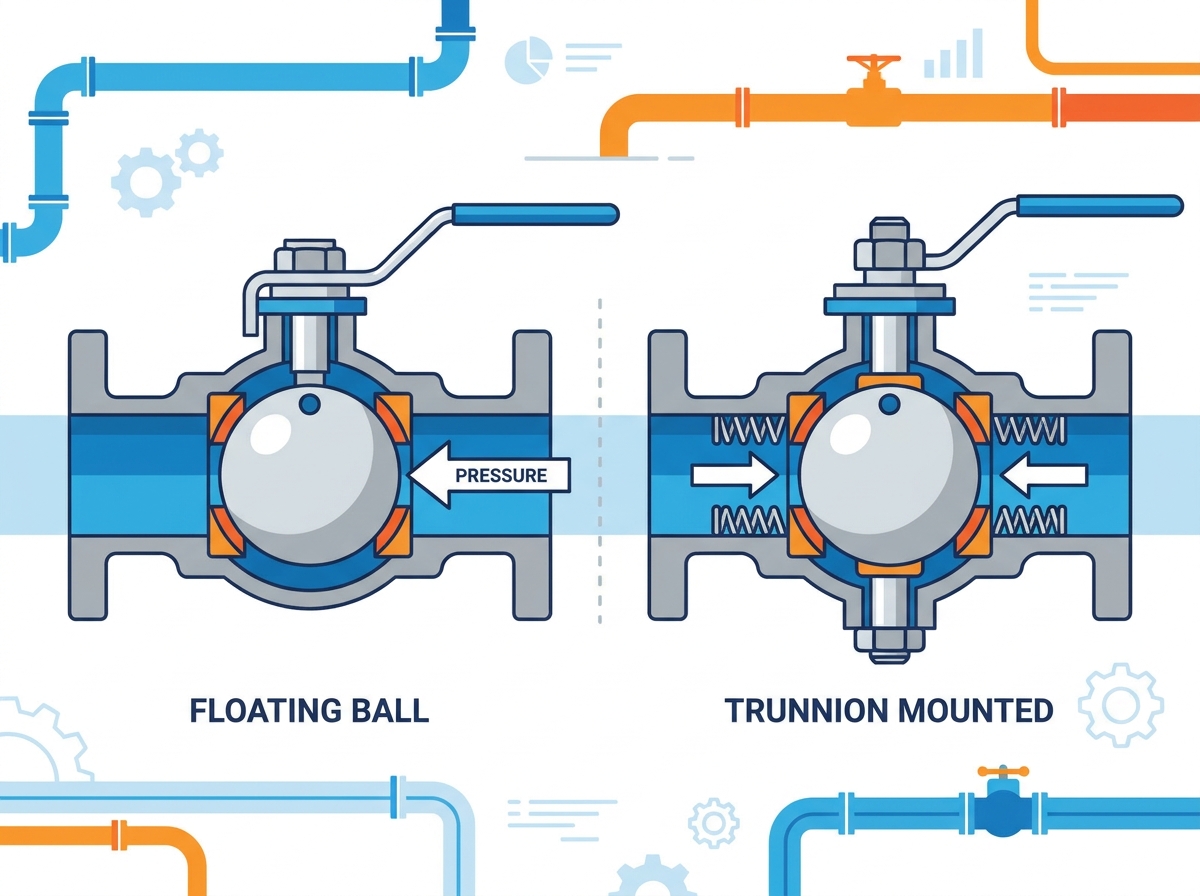
Engineered specifically to overcome the physical bottlenecks of the floating design, a trunnion ball valve utilizes a robust mechanical anchoring system. The ball is secured at both the top via the stem and the bottom via a trunnion shaft or pin. This rigid anchoring ensures that the ball rotates strictly on a fixed, vertical axis. It absolutely cannot be pushed downstream by volatile fluid pressure.
Because the ball remains completely stationary, the sealing mechanism must operate in reverse. Instead of the ball moving toward the seat, the dynamic line pressure forces independent, spring-loaded seat rings inward against the fixed ball. This architectural shift absorbs the massive thrust generated by high-pressure fluids. It directs the kinetic force safely into the forged steel body rather than onto delicate polymer seats.
The fixed-axis design drastically reduces the friction between the ball and the seats. This results in remarkably low operating torque, even under extreme pressure differentials. This mechanical advantage allows engineers to specify smaller, less expensive actuators for automated systems. These heavy-duty units easily handle severe pressure ratings up to ASME Class 2500 and beyond. Manufacturers produce them in massive sizes, scaling from 2 inches all the way up to 48 inches or more. Additionally, they natively support Double Block and Bleed capabilities, a non-negotiable safety feature for pipeline maintenance.
The sophisticated engineering does come at a premium. Trunnion variants require a significantly higher initial procurement budget. They are heavier, bulkier, and feature a much more complex internal structure. This includes internal springs, injection fittings, trunnion bearings, and additional sealing O-rings. Such structural complexity necessitates specialized maintenance procedures executed by highly trained technicians.
Trunnion designs are the undisputed heavy-duty workhorses of critical infrastructure. They are the mandatory standard in massive transmission pipelines, high-pressure gas processing plants, and compressor stations. You will also find them in subsea manifolds and Emergency Shutdown systems where immediate, reliable closure is absolutely critical regardless of line pressure.
The fundamental distinction between these two categories lies in their sealing mechanics. It simply boils down to whether the ball moves to the seat, or the seat moves to the ball. In a floating setup, the seats remain stationary while fluid pressure dynamically displaces the heavy steel ball. In a fixed-axis setup, the ball is locked in place. Dynamic line pressure, assisted by internal coil springs, pushes the floating seats against the ball. This singular difference dictates every other performance metric on a project site.
Respecting physical limitations is crucial for safe pipeline design. Exceeding these parameters risks catastrophic seat failure and severe environmental hazards. The table below illustrates the typical operational boundaries you must follow:
Feature | Floating Design | Trunnion Design |
|---|---|---|
Sealing Mechanism | Ball moves against stationary seat | Spring-loaded seats move against fixed ball |
Typical Size Range | 1/2 inch to 6 inches | 2 inches to 48 inches and larger |
Pressure Class Limits | ASME Class 150 to 300 | ASME Class 150 to 2500+ |
Double Block & Bleed | Not typically available | Standard built-in feature |
Operating Torque | High, increases exponentially with pressure | Low, thrust is absorbed by fixed axis |
Torque is a critical factor when designing automated pipeline systems. High line pressure on an unanchored ball creates massive friction against the downstream seat. Consequently, the rotational force required spikes dramatically. Automating a floating unit in a high-pressure line demands a massive, expensive actuator. By absorbing the line pressure through structural anchors, the trunnion design minimizes this friction. Therefore, they require significantly less torque, making them far more economical to pair with efficient pneumatic or electric actuators.
Looking at current global energy dynamics, there is a clear operational shift toward deeper extraction sites and highly aggressive fluid profiles. Unconventional shale gas and deepwater drilling expose equipment to unprecedented stress. As environmental regulations tighten globally, operators are strictly prioritizing zero-fugitive-emission setups.
This industry-wide trend significantly drives the demand for heavily engineered trunnion designs. Modern infrastructure requires valves that can accommodate automated monitoring and maintain absolute seal integrity under volatile pressure spikes. Baseline utility valves simply cannot survive these conditions. Compliance with rigorous standards like API 6D is no longer optional. It is a strict mandate for ensuring cavity pressure relief and safe maintenance testing in modern high-pressure gas processing facilities.
The manufacturing process of the exterior body is just as important as the internal mechanics. Cast bodies are created by pouring molten steel into a pre-shaped mold. This process is highly cost-effective and allows for the rapid production of complex shapes. It remains the standard for most floating units. While casting is perfectly suitable for low-to-medium pressure applications, the cooling process can occasionally introduce microscopic defects like porosity or shrinkage cavities. This makes cast bodies less desirable for extreme stress scenarios.
Forging involves shaping solid blocks of heated metal under immense mechanical pressure. This rigorous process alters the metallurgical grain structure, perfectly aligning it to the shape of the component. The result is a material with exceptional tensile strength, superior fatigue resistance, and a complete absence of internal porosity. For heavy-duty units deployed in harsh environments, such as subsea tiebacks or sour gas processing, forged materials are absolutely critical. They prevent body rupture and ensure decades of safe, uninterrupted operation.
The very first step in procurement is evaluating the physical dimensions and operating pressure of your pipeline. Follow this general engineering rule of thumb. If your pipeline is larger than 8 inches in diameter, or if the operating pressure exceeds ASME Class 600, you should immediately default to a trunnion design. Pushing a floating unit outside these parameters introduces severe safety risks to your crew.
The physical state and chemical composition of the fluid dictate your internal materials. For clean liquids and gases at standard temperatures, soft elastomeric seats such as PTFE or PEEK provide excellent, bubble-tight sealing. However, if the media contains abrasive particulates like sand in crude oil, soft seats will rapidly degrade. The same applies if temperatures exceed 400 degrees Fahrenheit. In these harsh scenarios, metal-to-metal seated configurations with hard-faced Tungsten Carbide coatings are absolutely mandatory.
Consider exactly how the equipment will be operated in the field. Will it rely on manual gear operators, or will it be integrated into a remote automated control system? Because actuator sizing is strictly dependent on operating torque, this step heavily influences the final decision. For automated systems in medium-to-high pressure lines, the lower torque of a fixed-axis design will drastically reduce the size, cost, and complexity of the required actuator.
Procurement managers must look far beyond the initial purchase order. A simpler floating design carries a lower upfront price tag. Yet, installing one in a borderline high-pressure application leads to frequent maintenance, continuous seat replacements, and incredibly costly operational downtime. In contrast, spending more on a robust anchored valve upfront almost always yields a lower Total Cost of Ownership. The savings realized from cheaper actuation and extended service life make the heavier-duty design the much smarter economic choice over a project's lifespan.
Selecting the correct mechanical type is only half the battle. Sourcing it from a reputable manufacturer is equally critical. Energy projects operate in zero-tolerance environments where a single failure can lead to environmental disasters. It is vital to partner with manufacturers who possess a proven track record of engineering excellence.
Procurement teams must rigorously verify strict quality control protocols, current ISO certifications, and full compliance with API 6D and API 607 fire-safe standards. Standard off-the-shelf equipment is rarely sufficient for highly specialized extraction operations. Whether you are dealing with highly corrosive sour gas requiring NACE MR0175 compliance or cryogenic temperatures in LNG terminals, the equipment must be tailored to the exact environment.
Top-tier manufacturers offer specialized oil and gas ball valves designed for these exact challenges. They work closely with project engineers to adapt baseline designs, select exotic forged alloys, and engineer custom seat profiles. This ensures flawless performance under the most demanding conditions imaginable.
Ultimately, the choice between a floating and a trunnion design comes down to pipeline size, maximum pressure, actuation torque, and project budget. Floating variants are the undisputed champions of small, low-pressure utility lines. Meanwhile, trunnion variants are the heavy-duty workhorses required for large, high-pressure transmission networks. Always consult with engineering experts before making a final procurement decision to ensure absolute safety and operational efficiency. If you are looking to source premium, API-certified equipment tailored to your specific project needs, explore the custom solutions available at Chinagoole Valve to secure the perfect match for your infrastructure.
Generally, no. While small-diameter floating units can handle moderate pressure, high pressure causes excessive friction against the downstream seat. This leads to rapid seat damage and extremely high operating torque. Ultimately, it makes the valve difficult or entirely impossible to operate safely. Trunnion designs are strongly recommended for all high-pressure environments.
A trunnion unit typically features an extra shaft, pin, or bolted cover plate at the bottom of the exterior valve body. This structure anchors the ball in place. They also frequently feature sealant injection fittings and a bleed valve on the body. Floating units lack this bottom anchor, resulting in a much simpler, smoother bottom exterior.
They possess a much more complex internal structure that requires precision machining. They utilize significantly more components, including internal coil springs, floating seat rings, trunnion bearings, and extra sealing O-rings. Furthermore, manufacturers often build them from heavy forged steel blocks to handle severe operational stress, which naturally drives up material and production costs.
Double Block and Bleed is a standard safety feature primarily found in trunnion designs. This is because both the upstream and downstream seats are spring-loaded and seal independently against the fixed ball. Floating designs typically do not offer true Double Block and Bleed functionality, as they rely on the ball moving downstream to seal against only one seat at a time.
Fully welded trunnion designs are the strict industry standard for buried underground transmission lines. The fully welded body completely eliminates flanged leak paths. This prevents fugitive emissions and allows the equipment to withstand shifting ground stress without compromising the seal over decades of buried service.
If the fluid temperature exceeds 400 degrees Fahrenheit, standard soft polymer seats like PTFE will rapidly soften, deform, and eventually melt. This results in immediate and catastrophic seal failure. For any high-temperature application, engineers must specify metal-to-metal seated valves, typically hardened with Tungsten Carbide, to withstand the extreme thermal stress.
As the pipeline diameter increases, the surface area of the internal ball also increases. This massively multiplies the lateral thrust force exerted by the fluid. Beyond 6 to 8 inches, this physical force becomes far too massive for a floating design to handle without crushing the downstream seat. Therefore, large pipelines mathematically require the structural anchoring of a fixed-axis design.


